61° and Clear
Image
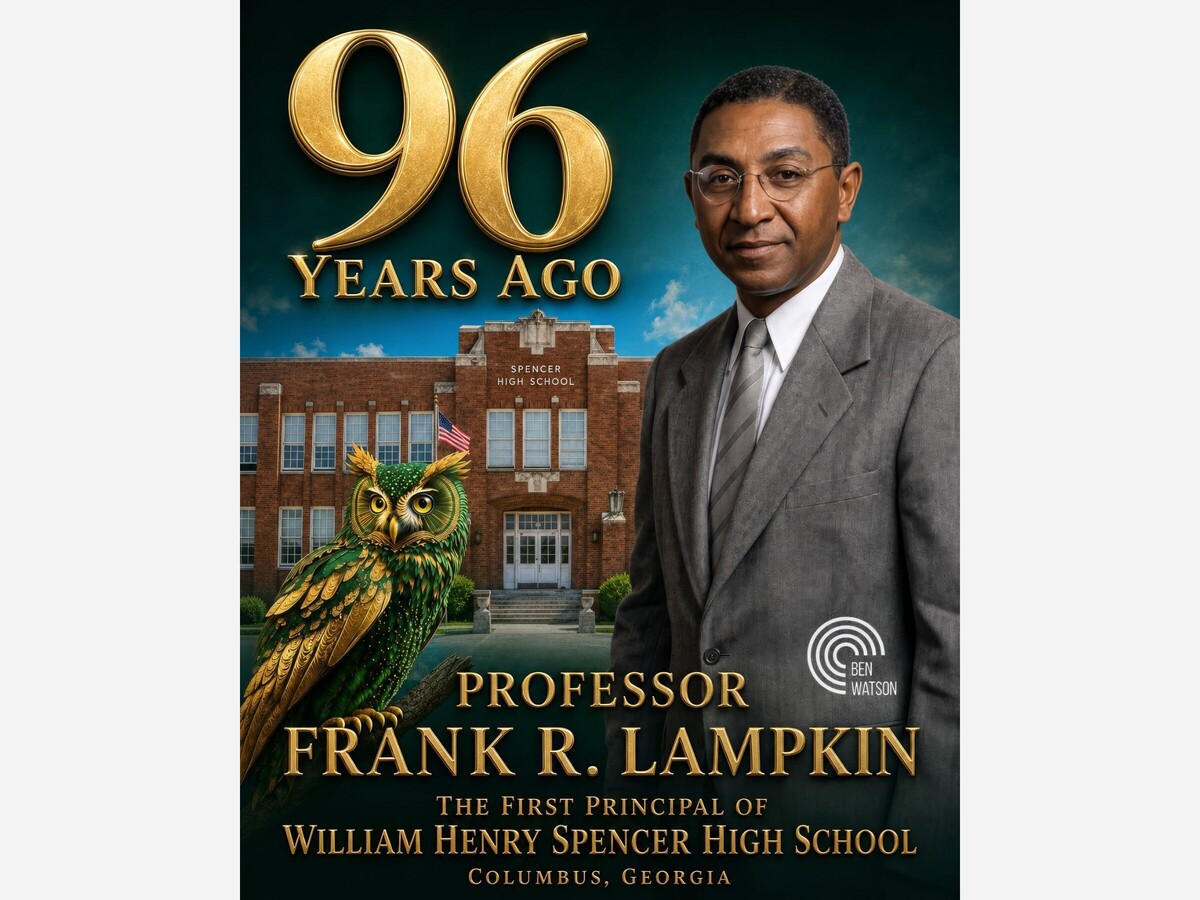
Credit to: Ben Watson



by Benjamin Watson, Columbus GA Native
Ninety-six years ago, Professor Frank R. Lampkin took on one of the most vital mandates in Columbus history: breaking through a system that denied Black students an education past the eighth grade.
Before 1930, the eighth grade was the absolute end of the line for Black children in the local public school system. Once students completed that final grade, the vast majority were pushed straight into low-wage domestic labor, manual factory work, or agricultural field jobs by design.
If a family was determined to get their child a real high school diploma, they faced an overwhelming financial burden. They had to pack up their children and send them away to live with out-of-town relatives in larger cities, or rely on the specialized preparatory high school departments that many Historically Black Colleges and Universities (HBCUs) operated at the time to bridge the massive gap created by Southern public school systems.
Sending a child off to an HBCU academy or private boarding school was an expensive sacrifice that kept secondary education out of reach for many working-class families.
That line was finally erased when William H. Spencer High School opened its doors as the first public high school for Black students in Muscogee County, placing Professor Frank R. Lampkin at the helm as its inaugural principal.
An institutional breakthrough means nothing without the master builder to run it, and Lampkin did not just step into leadership; he carried the entire weight of Black educational advancement in West Georgia on his shoulders.
Long before arriving in Columbus, Lampkin had already proven himself as an elite administrative force. Born in the late 1880s, he refined his intellect at Atlanta University, mastering classical literature, educational theory, and normal-school pedagogy.
By 1919, while serving on the faculty at Georgia State Industrial College (now Savannah State), his brilliant mind gained statewide prominence when he was chosen to represent Georgia at the International Student Volunteer Convention in Iowa, establishing himself as a national voice for youth development.
Seven years later, in 1926, he took on the presidency of Americus Institute, stepping directly into the storm of a historic Black secondary school drowning in debt. In two relentless years, Lampkin restructured the treasury, erased the liabilities, and restored the school's academic accreditation.
When Columbus needed a proven leader in 1930 to build an institution from scratch, Lampkin was in his early 40s, battle-tested, and ready. He did not just take command of Spencer High as its inaugural principal; he simultaneously served as the Supervisor of Colored Schools for Muscogee County from 1930 to 1945.
For 15 relentless years, Lampkin operated in a dual role, managing the daily rigor of a brand-new high school while fighting at the county level for equal funding, updated textbooks, and expanded academic and industrial trade tracks for every Black child in the district.
Under his direction, Spencer High became an early forerunner of what we now call Career, Technical, and Agricultural Education (CTAE), pairing rigorous classical academics with specialized vocational pathways so Black youth could build real economic independence in skilled trades and technical careers.
He fought through segregation, underfunded budgets, and institutional neglect to build a powerhouse of academic and industrial excellence that educated generations of Black leaders, thinkers, and innovators.
Frank R. Lampkin did not just manage a school; he architected a legacy of Black mobility in the deep South.
Let's discuss: Nearly a century ago, Professor Lampkin refused to force students to choose between college preparation and technical skills, proving that true mobility requires both. Are modern schools striking that critical balance between university readiness and hands-on Career, Technical, and Agricultural Education (CTAE) pathways, or have we swung too far in one direction?
Benjamin Watson is a 1986 graduate of Columbus (GA) High School (GA), a 1991 graduate of Voorhees College, and he received an MBA at Claflin University in 2008. He currently lives in North, SC.



Sunny, with a high of 88 and low of 61 degrees. Sunny for the morning, clear in the afternoon and evening,








I just wanted to clarify that District Judge Richard Leon was in fact the first to tell tRump that he is a "steward"of the White House not the owner. And to treat it as such.